
9 min read · Updated October 14, 2026
A downtown display has to survive wind, salt and tight sidewalks while giving shoppers a reason to stay. This guide covers the four display types that work on a main street, the permissions and power details, and a timeline that starts in September.
Key takeaways
- 1Pole-mount decor, tree wraps, overhead spans and one strong photo-op cover most BIA needs; start with poles and the photo-op.
- 2Get written permission for any pole, bracket or span before you order, because the pole owner and the road authority are often different.
- 3Run decor on 24V low-voltage transformers in weatherproof, lockable boxes, and put every circuit on a timer or photocell.
- 4Choose bracket hardware for the pole type and wind exposure, and keep a standard piece size so brackets are interchangeable.
- 5Order by September for a mid-November install; large 3D and overhead pieces and installer crews book up first.
A business improvement area has a specific holiday problem: dozens of independent merchants share a street, nobody controls the poles, trees or power, and the display has to read as one coordinated destination. The good news is that a handful of display types do most of the work. This guide covers what performs on a Canadian main street, how to deal with pole ownership and electrical details, and a realistic timeline that keeps a mid-November lighting night on schedule.
The four display types that work on a main street
BIAs that get the most from their budget tend to layer four things: repeating pole decor for rhythm, lit trees for warmth at eye level, an overhead feature for the gateway, and one lit photo-op that gives people a reason to stop and share. Each solves a different problem.
Pole-mount decor
Snowflakes, shooting stars, candy canes and wreaths mounted on street light poles create a continuous visual line down the block. They are the backbone of most BIA displays because they use existing infrastructure and need no sidewalk space. See the pole-mount decor range. Use a consistent piece size on a given block, usually 3 to 5 ft, and alternate two designs rather than mixing five.
Tree wraps with mini lights
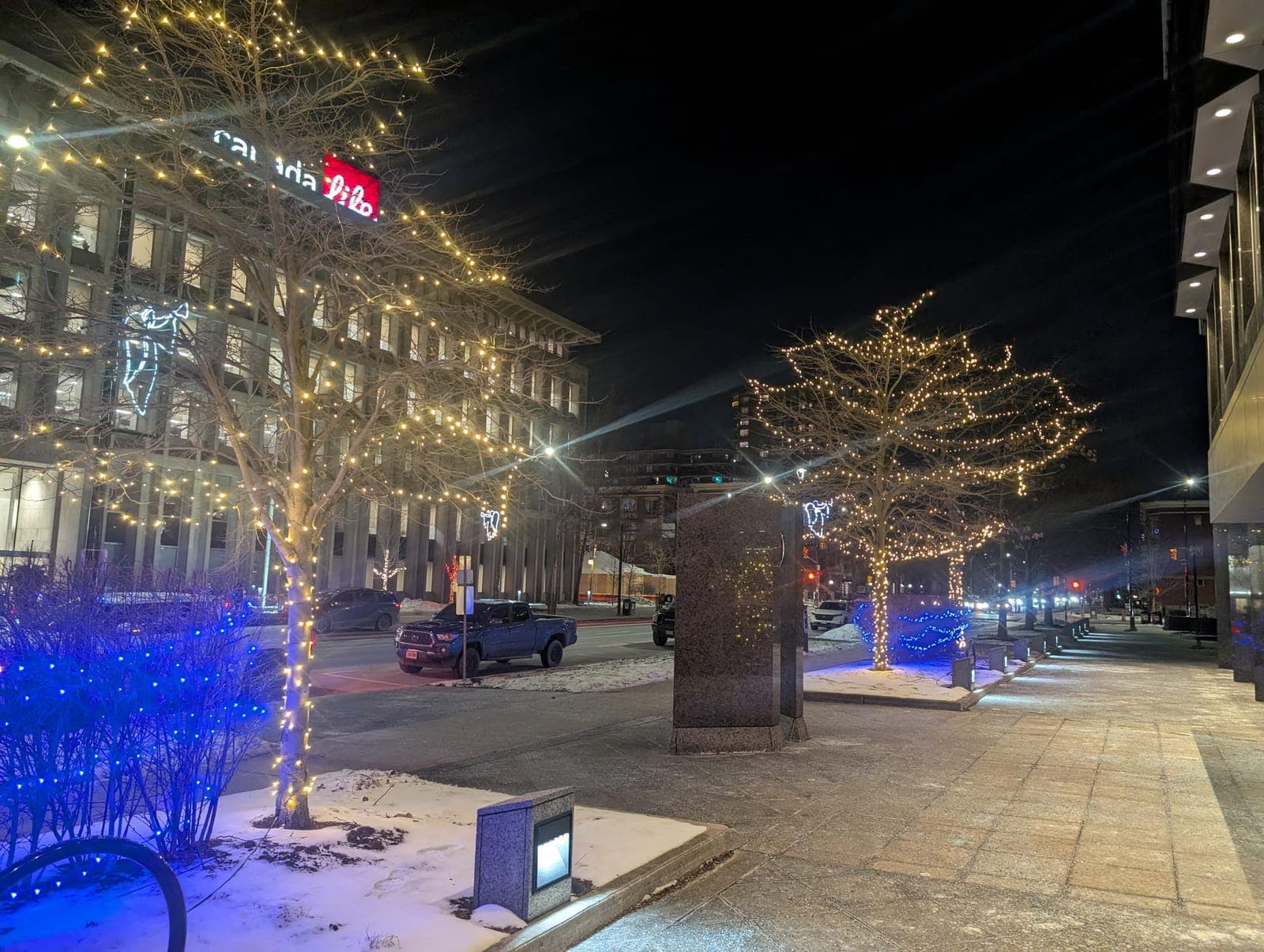
Street trees are the best use of 5mm mini lights. Wrap the trunk and first branches at a tight spacing of about 4 inches for a dense look, or run vertical strands up the canopy for taller trees. Plan on one outlet or 24V feed point per tree cluster, and use warm white for a traditional look or a single accent colour tied to your branding.
Overhead spans
A 40 ft street-crossing message, such as a Merry Christmas banner, announces the district at its entrances. These need engineered anchor points and road authority sign-off, so treat them as a second-phase item unless the poles are already rated. See overhead and skyline decor.
Lit photo-ops
A walk-through archway, giant ornament ring, gift box or polar bear gives visitors a place to take photos, and every photo is free advertising for your merchants. Put it where the sidewalk is wide enough for a group and where lighting from storefronts helps. Browse photo-op displays and 3D displays.
Permissions: who owns the pole?
In many Ontario towns the street light poles belong to the municipality, but in others they belong to the local distribution utility, and wooden hydro poles are almost always the utility's. Overhead spans cross a public road, so the road authority is involved as well. Do this work in summer, before you order.
- Identify the owner of every pole on your plan: municipality, utility or private. Ask for the pole map or inventory.
- Request written permission for attachments, with the maximum weight and wind-load the owner allows. Pole-mount pieces are light, but ask for a number.
- Confirm whether crews need traffic control or a road occupancy permit for lift work, and who issues it.
- Ask about clearance rules near overhead conductors; most owners require that you never mount on a pole with energized lines at your working height without their crew.
- Check that your insurance names the municipality or utility as required, and that your installer carries their own liability coverage.
Mounting hardware and wind
Match the bracket to the pole: round metal poles take band-style brackets, while some decorative poles have existing banner arms you can reuse. Choose one standard piece size per block so brackets are interchangeable and crews are not hunting for the right fitting at 5 pm in November.
- Use stainless or galvanized hardware and lock washers; road vibration loosens plain bolts over a season.
- Mount pieces with the centre of gravity close to the pole to reduce swing, and use a secondary tie on anything over 4 ft.
- Photograph each mounting position and record the pole number so next year's install repeats the same height and orientation.
- Plan for a mid-season walk-through after the first big windstorm to re-tighten and replace any failed pieces.
Power: 24V, transformers and timers
Most commercial LED decor is built for 24V low-voltage operation and comes with a transformer. The transformer, not the decoration, is the part exposed to moisture and tampering, so give it a weatherproof, lockable enclosure mounted well above snow and splash height. Check that your displays are IP44 rated or better, then protect the plug-in connections with sealed covers.
- Add up watts per circuit and keep continuous load under 80 percent of breaker capacity: 1,440 W on a 15 A, 120V circuit.
- Keep low-voltage runs as short as possible; long 24V runs show up as dimmer pieces at the end.
- Put each circuit on a timer or photocell so the display turns on at dusk and off at a set hour, such as 11 pm, to save energy and extend piece life.
- Use outdoor-rated extension cords and wire with GFCI protection, and label each cord with the piece it feeds.
- Have a licensed electrician sign off on any new outlet or pole-base receptacle, and keep the paperwork with your BIA records.
Merchant coordination and storefront lighting
Merchants can extend the BIA display with their own storefront lighting if you offer a spec. Publish a one-page guide: warm white C9 lights at one bulb per foot along rooflines, with a recommended colour palette. Merchants can buy the C9 LED bulbs in 25-packs, starting from $45, and plug them into spool wire. A coordinated palette makes a block of independent storefronts read as one display.
Winter operations: snow, access and vandalism
A downtown display has to work in the conditions that define a Canadian December. Plan the operating side before the first piece goes up, and agree on responsibilities with the municipality and your installer.
- Snow clearing: keep transformer enclosures and receptacles out of plow windrows and sidewalk snow storage, and tell the winter maintenance contractor where they are.
- Accessibility: keep sidewalks clear to at least 1.5 m (about 5 ft) around photo-ops and tree wraps, and cover or route any cords crossing a path.
- Tamper resistance: use lockable enclosures, mount low-level pieces out of casual reach and consider securing cables to the tree or pole with ties.
- Service plan: name one person to receive reports of dark sections, and keep spare bulbs, transformers and brackets in a labelled bin within a short drive.
- Weather response: after ice storms or high winds, inspect brackets, spans and tree wraps before restoring power to affected circuits.
Programming the display to drive foot traffic
Lights alone do not bring people downtown; events do. The strongest BIA displays are tied to a calendar that gives shoppers a reason to visit more than once. A lighting night with performers, extended retail hours and a map of the display is the standard anchor. Add a Santa visit weekend near the photo-op, a merchant passport that rewards visiting multiple shops, and a photo contest with a branded hashtag. Place the photo-op where the best photograph also includes storefronts, so merchants share in the exposure.
Timeline: start in September
BIAs that start in August or September rarely scramble. Work backwards from your lighting night.
- June to August: pole inventory, permissions, electrical audit, budget approval.
- By mid-September: submit your inquiry through the quote request form with item list, quantities and delivery address.
- Late September to early October: confirm pricing, shipping cost and arrival date; book your installer or municipal crew.
- Mid October: receive and test every piece on the ground before it goes up. Tag failures right away.
- First two weeks of November: install, commission circuits and set timers.
- Lighting night: usually the third or fourth Saturday of November.
After lighting night
Treat January as part of the plan. Schedule takedown with the same crew, inspect each piece, and label it with its pole number before it goes into storage. Pack lit pieces flat or on their sides, never stacked under weight, and keep transformers dry. Record failed pieces now so you can order replacements in spring. More BIA-specific information, including net-30 invoicing and tax-exempt handling, is on the BIA and downtown page, and the commercial overview lists other property types.
Frequently asked questions
What is the best Christmas decoration for a downtown main street?
Pole-mount decor gives the most coverage for the money because it uses existing poles and needs no sidewalk space. Pair it with wrapped trees and one lit photo-op display. Add an overhead span later once permissions and anchors are sorted out.
Do we need permission to mount decorations on hydro poles?
Yes. Utility-owned poles require written permission and often their own crew or approved contractor for work near conductors. Municipal street light poles usually need a permit or agreement as well. Identify pole owners in summer, before you order.
How do we power pole-mount decorations safely?
Use 24V low-voltage pieces with transformers in weatherproof, lockable enclosures, GFCI-protected outdoor cords, and a timer or photocell on each circuit. Keep continuous load under 80 percent of the breaker rating and have a licensed electrician approve any new outlet.
When should a BIA order for a November lighting night?
Submit your inquiry by mid-September. That leaves time for pricing, shipping, ground testing and installer scheduling, with installation in the first two weeks of November.
Can a BIA get net-30 invoicing and tax-exempt purchasing?
Yes. Municipalities and BIAs can request net-30 invoicing, tax-exempt handling and line-item quotes. No payment is taken online; the team replies to your inquiry by email.
Put it into an order
Everything in this guide ships from London, Ontario.
Commercial-grade C9, displays, pole décor, wreaths and garland, quoted line by line with freight within one business day.
Keep reading
Commercial planning · 9 min
Commercial Christmas Decorations Budget: A Planning Guide for Canada
Malls, BIAs and municipalities rarely overspend on the decorations themselves. The overruns come from labour, power, storage and replacement. This guide gives CAD planning ranges per pole, tree and entrance, plus a three-season phasing model.
Commercial planning · 9 min
Shopping Mall Christmas Decorations: A Checklist for Centre Managers
A mall display is a traffic-management project as much as a decorating one. This checklist covers atrium tree sizing, Santa set and photo-op layout, walk-through displays, fire-rated materials, lead times and how to refresh themes without rebuying everything.
Commercial planning · 9 min
Municipal Christmas Lights Procurement: Writing an RFP or Tender That Works
A vague holiday lighting tender attracts vague bids. This guide shows parks and public works staff how to write measurable specs, evaluate bids on total cost, set delivery windows and decide between staff installation and a contractor.