
8 min read · Updated October 14, 2026
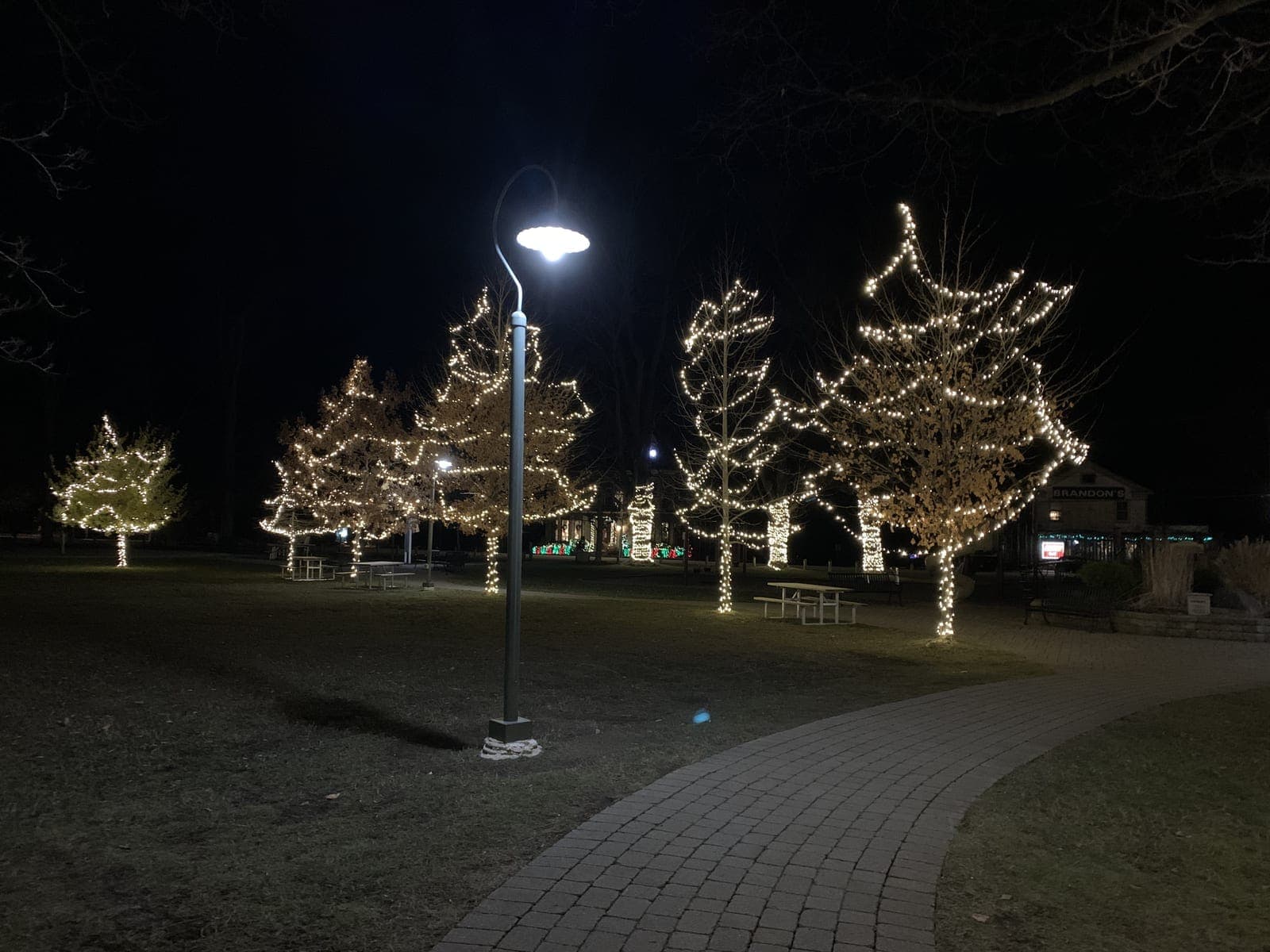
Wrapped trees are the backbone of most BIA and plaza lighting plans, but trunk wraps fail when spacing, footage and removal timing are guessed. This guide covers trunk versus canopy wraps, 5mm mini light spacing, footage by trunk diameter, power runs and street tree rules.
Key takeaways
- 1Choose the method by goal: trunk wraps for a clean, low-cost glow, canopy wraps for a full tree silhouette that reads from a distance.
- 2Space wraps 3 to 4 inches apart on the trunk, and use the footage table in this guide to order lights by trunk diameter instead of guessing.
- 3Mini light strands draw very little power, so the limit on a tree run is the strand connection maximum and the cord, not the circuit.
- 4Put every tree on a timer or photocell, and use GFCI-protected outdoor outlets with weatherproof connection covers.
- 5Remove trunk and branch wraps by late winter, before sap flow and growth, so nothing girdles the tree.
Trees are the cheapest way to make a street or plaza look lit. A row of wrapped trunks creates rhythm along a sidewalk, frames storefronts and reads clearly from a passing car. But tree wraps go wrong in predictable ways: crews run out of strand halfway up the tree, wraps are spaced too far apart to look like anything, or the lights stay on past March and bite into the bark. This guide gives facility managers, BIA coordinators and installers a repeatable method, with footage numbers, power math and removal timing built in.
Trunk wrap or canopy wrap?
There are two main approaches, and the choice should be made per tree, not per project.
- Trunk wrap: a spiral of lights from the base up the trunk, sometimes continuing onto the first main limbs. It is fast, uses predictable footage and works for any tree with a visible trunk. Best for dense streetscapes where you want rhythm along the sidewalk.
- Canopy wrap: lights follow the major branches out to the secondary limbs. It takes longer and needs a lift or ladder, but the tree reads as a full glowing shape from 50 m or more. Best for focal trees in a plaza, at a mall entrance or on a roundabout.
- Combined: trunk wrap plus the first tier of major limbs. This is the best value for most BIA streets, since it looks complete from the sidewalk without the labour of a full canopy.
Deciduous trees such as maples, lindens and ash look best with warm white mini lights, since the bare branches in winter are dark and the lights outline the structure. Evergreens can take colour, but warm white remains the safest choice for a coordinated streetscape.
Choosing the lights
For wrapping, use 5mm mini light strands in LED. The small bulbs sit close to the bark, the wire is thin enough to wrap tightly and LEDs draw a fraction of the power of older incandescent strands. Look for commercial-grade strands with a green or brown wire so the cable disappears into the bark or foliage, and check the label for the maximum number of strands that can be connected end to end.
For canopy work on larger trees, consider C9 LED bulbs on socket wire. C9 reads from much further away, so it suits trees at a distance such as a park entrance. The trade-off is weight and wind load on small branches, so keep C9 to main limbs and use mini lights for secondary branches.
Spacing and footage: the table
The most common mistake is ordering by number of trees rather than by trunk size. The footage you need depends on the circumference of the trunk and the gap between wraps. Circumference is the trunk diameter times 3.14, and the number of wraps is the wrapped height divided by the spacing. Spacing of 3 to 4 inches between wraps gives a dense, even glow. Wider than 6 inches and it starts to look like stripes.
The figures below are for 6 ft of wrapped trunk height, at 4 inch and 3 inch spacing. Add about 10% for the base loop, the tail to the power connection and the occasional re-wrap.
- 4 inch trunk diameter: about 19 ft of lights at 4 inch spacing, 25 ft at 3 inch spacing.
- 6 inch trunk: about 28 ft at 4 inch spacing, 38 ft at 3 inch spacing.
- 8 inch trunk: about 38 ft at 4 inch spacing, 50 ft at 3 inch spacing.
- 12 inch trunk: about 57 ft at 4 inch spacing, 75 ft at 3 inch spacing.
- 18 inch trunk: about 85 ft at 4 inch spacing, 113 ft at 3 inch spacing.
For each additional foot of wrapped height, divide the figure for 6 ft by 6. A 6 inch trunk wrapped to 12 ft at 4 inch spacing needs about 57 ft plus 10%, which rounds to 62 ft. For canopy wraps, treat the major limbs like small trunks, and as a rough starting point plan 300 to 500 ft of strand for a 15 to 20 ft street tree wrapped on the trunk and the first tier of limbs. Count a few sample trees on your street and extrapolate, rather than relying on this estimate for a large order.
How to wrap the trunk, step by step
- Test every strand on the ground before it goes up. Plug in, confirm all lights are on, and replace anything with dead sections.
- Start at the base with the plug end near the power source. Leave a tail of 2 to 3 ft for the connection.
- Anchor the first wrap with a cable tie or soft clip loosely, never staples or nails.
- Wrap upward in an even spiral at 3 to 4 inch spacing, keeping the strand snug but not tight. The wire should sit on the bark, not bite into it.
- Use a second person to feed the strand from a reel or bag, so it does not tangle or kink as you climb.
- At the first main limb, either finish with a clip and a tail, or continue along the limb for a combined wrap.
- Connect strands end to end only up to the maximum run on the label, and wrap connection points with weatherproof tape or boot covers.
For large crews, work in pairs along a street. One person wraps, the other manages the power, the tester and the log of which tree is on which outlet. A simple spreadsheet with tree number, trunk size, footage used and outlet location makes next year's order and your takedown far faster.
Power runs, timers and GFCI
LED mini lights draw very little power. A typical 100-light LED strand draws somewhere in the range of 4 to 7 W, so even 20 strands is only about 100 W. One 15 A circuit gives you 1,800 W, or 1,440 W at the 80% continuous-load limit, so power rarely limits a tree run. What limits it is the maximum number of strands you can connect end to end, the length of extension cord to the nearest outlet and the number of trees per receptacle.
- Plan one weatherproof outlet per tree or per pair of trees, and keep cord runs under 50 ft where possible.
- Use outdoor-rated 14 or 12 gauge extension cords for long runs, and cover the connections with weatherproof boots.
- Protect every outdoor circuit with a GFCI, either in the receptacle or at the panel.
- Put each block of trees on an outdoor timer or photocell so the whole street comes on at dusk and shuts off at the same hour, typically 11 pm or midnight.
- On sidewalks, run cords along the tree pit or the curb edge and protect crossings with cord ramps so nobody trips.
Plan the power before you wrap. If a tree is 80 ft from the nearest outlet, you either need a heavier cord, a new outlet or a different tree. Our accessories range includes timers and clips sized for commercial work.
Street trees, BIAs and municipal rules
In a BIA or on a public street, the tree belongs to the municipality, and wrapping it usually needs approval. Contact the parks or forestry department early, ideally in August, and ask about their rules. Common requirements include no staples, nails or adhesives, no tight wraps on young trees, a removal date and proof of insurance. Some municipalities limit wrapping to the trunk and the first main limbs, and some ask that wraps be checked mid-season.
Young trees with thin bark and small trunks need extra care. Use a loose spiral at 6 inch spacing rather than 3 to 4, and skip the wrap altogether if the tree is under about 4 inches in diameter and the municipality objects. For BIAs managing dozens of trees, a single approved method written into your contract with the installer makes approval much faster. The BIA and downtown page covers how we work with associations on volume orders.
Maintenance and removal
Check wraps once in December and again in January. Wind and snow can shift strands, and ice can add weight. Loosen anything that looks tight and replace failed strands. Do not leave a failed strand in place, since a dark section looks like a gap in the street.
Remove everything by late winter. In Ontario that usually means by the end of February or the first half of March, before the sap runs and the trunk begins to expand. A wrap left on through spring can leave a spiral scar or restrict growth, and municipalities will often charge for damage. Cut cable ties rather than pulling them, coil strands onto a reel or into a bin, and store them dry with the tree number on the label so they go back to the same tree next year.
Ready to size an order? Add products to your cart and submit an inquiry. The team replies by email, usually within one business day, with shipping cost, timeline and volume pricing. Free shipping applies over $150, and municipalities and BIAs can request net-30 invoicing and line-item quotes.
Frequently asked questions
How far apart should I space the wraps on a tree trunk?
Use 3 to 4 inches between wraps for a dense, even glow. At more than 6 inches the trunk starts to look striped. For young trees with thin bark, use a looser spiral at about 6 inches.
How many feet of lights does a tree trunk need?
It depends on trunk diameter. For 6 ft of wrapped height at 4 inch spacing, a 6 inch trunk needs about 28 ft, an 8 inch trunk about 38 ft and a 12 inch trunk about 57 ft. Add 10% for the base loop and the tail.
How many mini light strands can run off one outlet?
Power is rarely the limit, since a 100-light LED strand draws only a few watts. The limit is the maximum number of strands you can connect end to end, which is printed on the label, plus the length and gauge of the cord to the outlet.
When should tree lights come down?
Remove them by late winter, usually the end of February or early March in Ontario, before sap flow and bud break. Leaving wraps on through the growing season can scar or restrict the trunk.
Do I need permission to wrap street trees?
Usually yes. Street trees belong to the municipality, so contact the parks or forestry department in August to confirm rules such as no staples, trunk-only wraps and a removal date.
Put it into an order
Everything in this guide ships from London, Ontario.
Commercial-grade C9, displays, pole décor, wreaths and garland, quoted line by line with freight within one business day.
Keep reading
How-to · 9 min
Holiday Lighting Power Requirements: Planning Circuits for Large Displays
Large displays fail on power, not on design: tripped breakers, undersized cords and overloaded transformers. This guide walks through 120V circuit math, watts per C9 LED and mini strand, 24V transformer sizing, GFCI, cord gauge by length, timers and a worked electricity cost.
Commercial planning · 9 min
Commercial Christmas Decorations Budget: A Planning Guide for Canada
Malls, BIAs and municipalities rarely overspend on the decorations themselves. The overruns come from labour, power, storage and replacement. This guide gives CAD planning ranges per pole, tree and entrance, plus a three-season phasing model.
Commercial planning · 9 min
BIA Holiday Lighting Guide: What Actually Works on a Canadian Main Street
A downtown display has to survive wind, salt and tight sidewalks while giving shoppers a reason to stay. This guide covers the four display types that work on a main street, the permissions and power details, and a timeline that starts in September.